
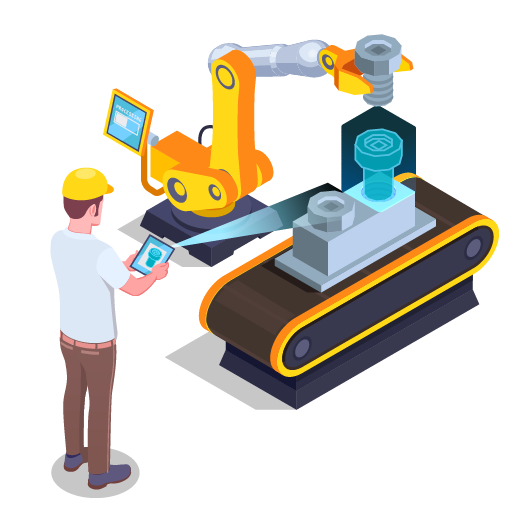
Prototyping & Solution Testing
The fundamental value of prototyping in any domain is the same: it moves the point of discovery from the worst possible moment — full-scale implementation, with no room to adjust — to the most manageable one: a controlled test with limited scope, limited investment, and maximum opportunity to observe, learn, and refine. In manufacturing, the difference between these two moments is the difference between a problem discovered on one workstation during a pilot requiring a minor adjustment and a problem discovered during a facility-wide rollout requiring a costly redesign and extended downtime.
Physical prototyping — of tools, jigs, fixtures, and handling equipment — generates benefits beyond confirming the design is functionally correct. When a prototype is used in real production conditions by the operators who will use the final version, feedback emerges that the designer could not have anticipated from the drawing office: the reach comfortable for an operator of average height is uncomfortable for the shortest and tallest; the handle adequate in the CAD model creates fatigue in sustained use; the clearance appearing sufficient in the drawing is inadequate when surrounded by other components present in real production sequence.
IT system prototyping in a production environment has specific character that distinguishes it from software development in other contexts: the production environment is the most significant variable and cannot be fully replicated in a test environment. Network connectivity reliable in the server room may be intermittent at the workstation location. User interface elements clear on a standard office monitor may be unreadable in production area ambient lighting. Prototyping in the actual production environment discovers these issues before they affect live production.
The organisational discipline of testing before committing — of requiring that any significant change be validated at pilot scale before full implementation — is itself a competitive capability. It reduces exposure to implementation failures, builds analytical skills of the teams conducting tests, and creates a culture in which evidence is required before investment. Organisations with this discipline make fewer expensive implementation failures, move faster because they trust their validation process, and learn more from each pilot.